Written by
 Reviewed by
Every AI request, whether it's a question to ChatGPT, Claude or Gemini, runs on GPUs in data centers around the world, and those GPUs draw power from the grid. As artificial intelligence use grows, so does the energy demand and power demand behind it, and with it, the carbon, water and wider environmental footprint.
How much energy a single request uses depends mainly on the model you pick, how many tokens you send and get back, the hardware it runs on, and where and when it runs. The carbon footprint then depends on how clean the local grid is at that hour. Water use comes from cooling the data center and from generating the electricity.
That's a lot of factors… Luckily Greenpixie is going to break it all down for you below! In this article we set out what drives AI energy consumption, how it affects the wider power grid, how to estimate it for your own AI usage, and which changes cut energy and costs at the same time.
How much energy does AI use?
There is no single figure per prompt. Energy per request varies by orders of magnitude between a small model answering a short question and a frontier model writing a long response.
Greenpixie benchmarked 32 open-weights frontier LLMs, from 1.7 billion to 1 trillion parameters, on NVIDIA H100 and B200 GPUs, sampling GPU power every 10 milliseconds. The research shows five main drivers of AI energy consumption:
- Model size: Larger AI models need more compute, and so more electricity, for every token they process. The same question uses more energy on a large model like Claude Opus than on a smaller one like Claude Haiku.
- Token type: Generating an output token takes more than ten times the energy of processing an input token. Input tokens are used in such large volumes, though, that across real usage the two often come out close in total.
- Hardware and quantization: Newer GPU technology and lower-precision formats such as FP8, INT8 and NVFP4 change the energy per token.
- Batching and caching: Serving many requests together, and reusing cached prompt prefixes, lowers the energy per token. Our benchmarks ran from 16 to 2,048 parallel requests to measure the difference between a real-time chatbot and an overnight batch job.
- Data center overhead: Cooling and power distribution add to the GPU energy. This overhead is measured as PUE, or power usage effectiveness.
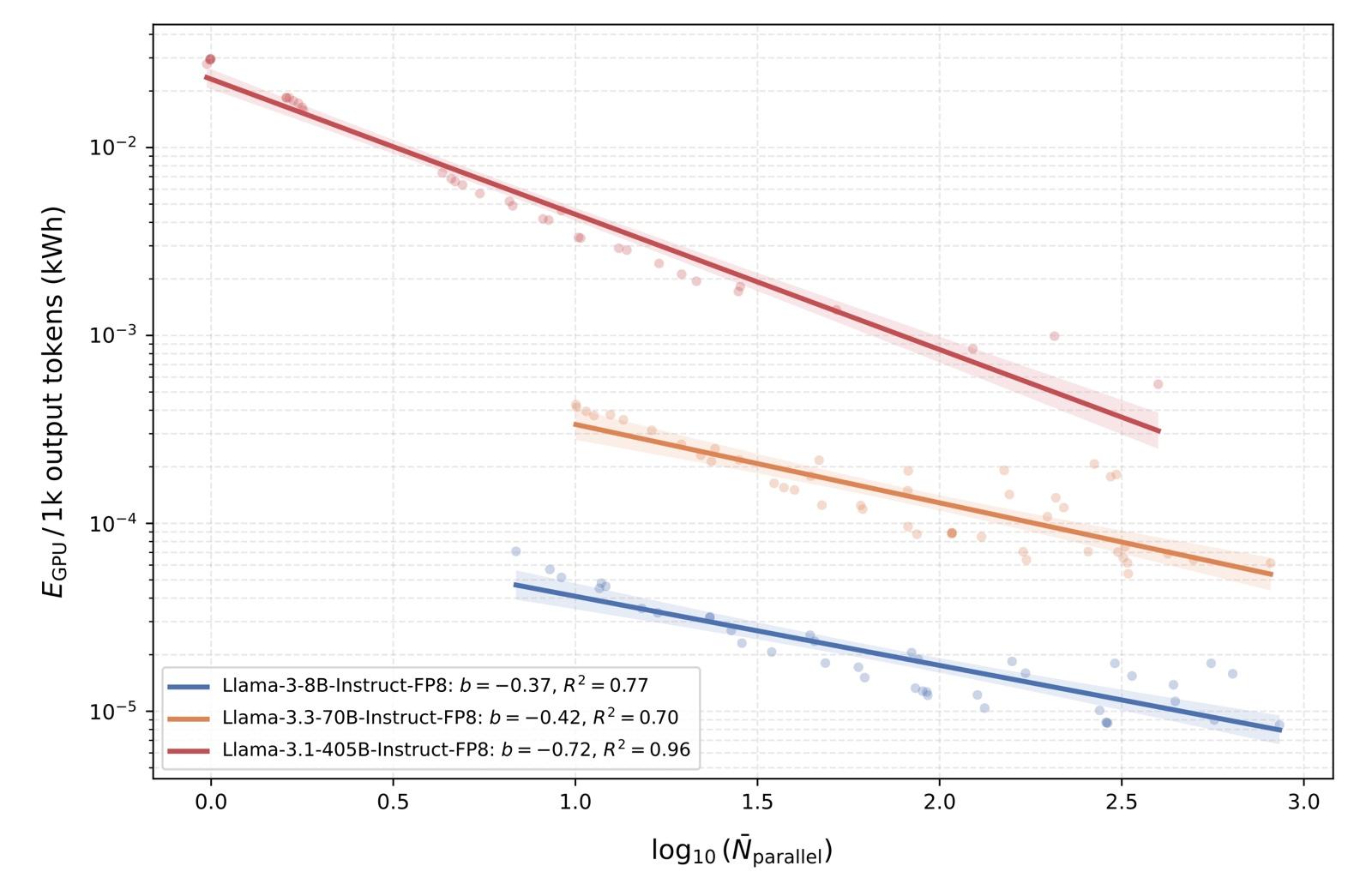
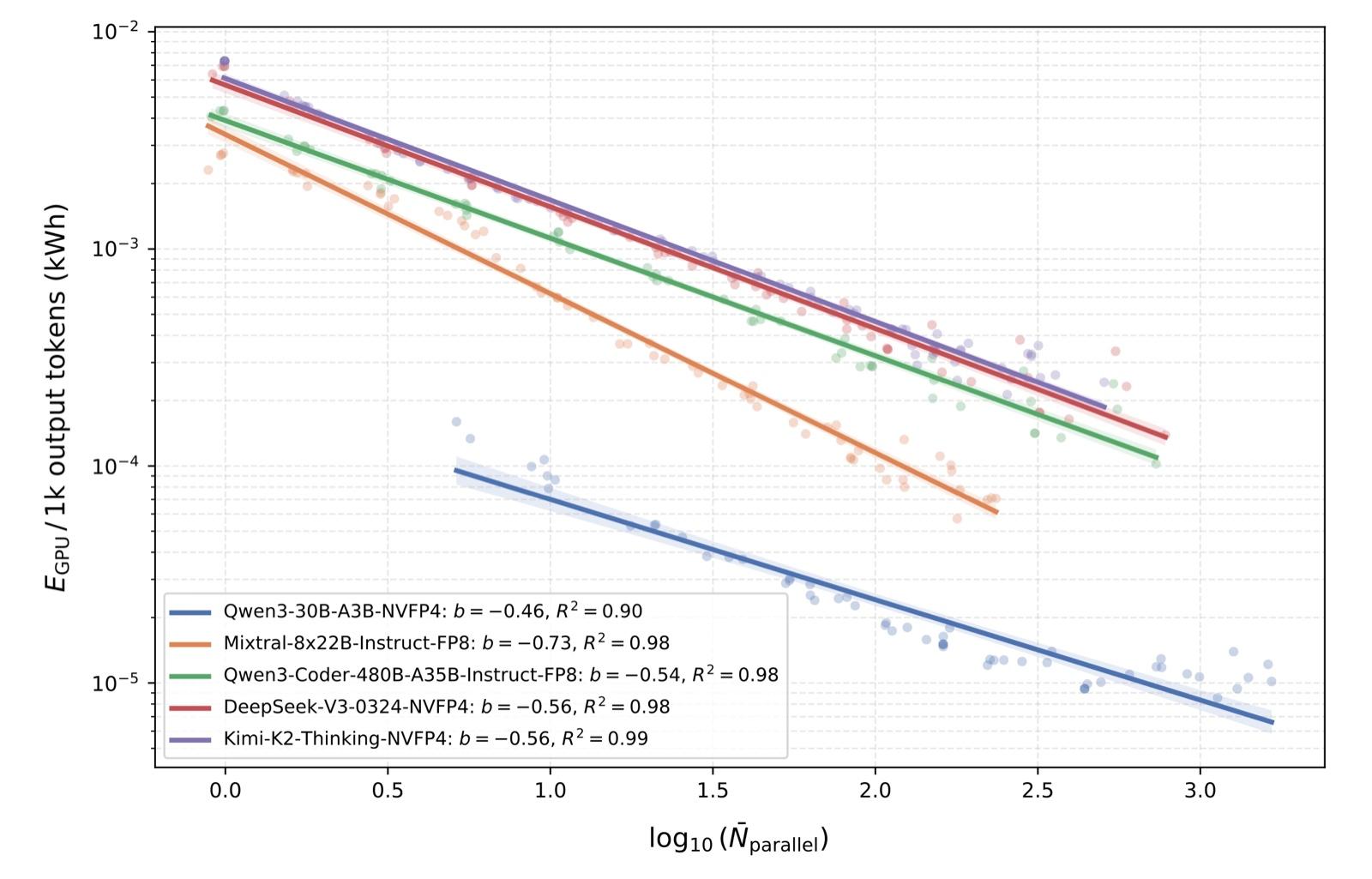
“The energy per token varies more than an order of magnitude for the larger models.”
To estimate your own usage, try GPX AI in our app.
Is AI draining the power grid?
AI is not draining the grid today, but it is one of the fastest-growing sources of energy demand, and the growth is concentrated in a few places.
According to the International Energy Agency (IEA), data centers used around 485 TWh of electricity in 2025, after growing 17% in a year. Consumption from AI-focused data centers grew even faster, by 50%. The IEA expects total data center demand to roughly double to 950 TWh by 2030, around 3% of global electricity demand.
In the United States, data centers account for nearly half of the growth in electricity demand between now and 2030.
Because data centers cluster in specific regions, the local effect can be much larger than the global share suggests. The IEA notes that electricity grids are already under strain in many places, and that around 20% of planned data center projects could be delayed by grid constraints. New AI data centers are now even often planned in gigawatts rather than megawatts… At that scale, AI infrastructure and data center power demand growth now feed into national energy plans and grid policy.
Will AI growth push up emissions in the future?
The IEA expects about half of the growth in data center electricity demand to be met by renewable energy, with the rest coming from fossil fuels such as gas, plus nuclear and other sources. In its base case, emissions from data center electricity use grow from around 180 million tonnes of CO2 today to around 300 million tonnes by 2035.
That is still below 1.5% of energy sector emissions. But it is growth at a time when most industry sectors need to cut greenhouse gas emissions to tackle climate change, which is why the efficiency of AI use, and the technology choices behind it, will shape the future of AI development and the wider AI industry.
What makes up the carbon footprint of AI
The energy footprint and carbon footprint of an AI workload have three parts:
- Electricity at run time: Energy used by GPUs, CPUs and the data center, multiplied by the carbon intensity of the local grid at the time it runs. The same request can have a very different footprint in a region running on wind and nuclear compared with one running on gas or coal.
- Embodied emissions: The emissions from manufacturing the GPUs and servers, spread over their working life, plus the natural resources used to make them and the electronic waste left when they are retired. These count as Scope 3.
- Water: Data centers use water for cooling, which adds to the resource consumption of AI. The amount depends on the site's water usage effectiveness (WUE) and the local climate, and it matters most in areas facing water scarcity.
+ energy per output token × output tokens
+ embodied emissions (Scope 3: making, shipping and disposing of hardware)
+ water used to generate the electricity
Because carbon depends on location and time, starting from energy gives a more consistent number. Carbon and water can then be worked out from the energy figure for each region.
Why AI provider data is not enough
Most organizations use AI through several routes at once, including cloud AI services on AWS, Azure and GCP, direct API access to model providers, and AI tools and agents built into SaaS products, such as ChatGPT Enterprise, Claude Team or Gemini in Google Workspace.
Each reports usage differently, usually as tokens or spend, and few report energy, carbon or water at all. Where tech companies do publish figures, the methods differ, so the numbers cannot be compared or added up.
To manage the environmental impact of AI you need one method applied across every route, at the level of model and token, so that engineering and FinOps teams can see the effect of each choice.
How to reduce AI energy consumption and emissions
Most of these changes cut energy usage and power consumption as well as costs, because AI providers charge by the token.
- Measure first: Find out which providers, tools, chatbots and AI agents your teams use, and where the usage and billing data is kept.
- Match the model to the task: Use smaller AI models, such as Claude Haiku, Gemini Flash or a GPT mini model, for classification, extraction and short answers. Keep the largest models for work that needs them.
- Cut output tokens: Ask for shorter answers and structured output where a long response adds nothing.
- Use prompt caching: Reusing a cached system prompt or shared context avoids processing the same tokens again.
- Batch non-urgent work: Batch APIs serve requests together, which is cheaper and uses less energy per request.
- Choose lower-carbon regions: Where latency and data rules allow, run workloads in data centers in regions with cleaner grids and more renewable electricity.
- Track it like cost: Put energy and carbon next to AI spend in the reports teams already use, so they see both when making decisions today and planning future AI usage.
Model choice makes the biggest difference. In Greenpixie's data, OpenAI's GPT-6 Astra uses about 49 times the energy of GPT-6 Luna for every output token, at around 100 times the list price.
“Next time you call an AI API, it is worth considering if this needs to be handled ASAP, or if it can wait a little while.”
How Greenpixie measures AI energy, carbon and water
GPX AI estimates the carbon, water and energy impact of AI across providers, SaaS tools and agents using one method. Any usage report that shows tokens by model and token type can be used, including cloud billing data, model provider API logs and per-seat AI tools. The dataset covers 500+ AI models.
- 32 open-weights LLMs benchmarked on H100 and B200 GPUs, using prompts from 14 public benchmark datasets
- Figures for input, output, cached input and embedding tokens, and for real-time, batch, priority and flex processing tiers
- Every value given as a median with an interquartile range, so the uncertainty is visible
- Data center overhead (PUE), training energy and embodied hardware emissions included
- Water covers both data center cooling and electricity generation, using factors developed with Dr Shaolei Ren at the University of California, Riverside
- Results cross-checked against independent research, including Jegham et al., the open-source EcoLogits tool, and metered energy data from enterprise clients
- Carbon, water and embodied emission factors come from Greenpixie's cloud methodology, which is aligned to the GHG Protocol and independently verified to ISO 14064-3. The AI per-token energy layer builds on these verified factors and is validated against independent research and metered energy data.
Impact by token type
Impact by model
The full method is set out in the public AI methodology and our white paper.
The same approach powers GPX Cloud, which adds carbon, energy and water data to every line of a cloud bill, so AI and wider cloud usage can be reported together.
Learn more about GPX AI here. Or try it in the app.
Frequently asked questions
Is AI bad for the environment?
AI has a real environmental footprint through its electricity use and the air pollution from fossil fuel power plants, the water used for cooling and the emissions from making the hardware. How large it is depends on how AI is used and where it runs: large data centers can put real pressure on local grids and water supplies, so the environmental consequences are often felt most locally. Choosing efficient models, cutting unnecessary tokens and running in cleaner regions all reduce its impact on the environment. The IEA also finds that AI could help cut emissions in other sectors in the future, for example by optimizing energy systems.
Is AI causing electricity bills to go up?
In some regions, fast growth in data center demand is putting pressure on grids, and the cost of new generation and grid infrastructure upgrades can feed into the energy costs other customers pay. The IEA notes that meeting data center demand can involve trade-offs with affordability. The effect varies a lot by country and region, depending on energy policy and how grid costs are shared.
How much energy does a single AI prompt use?
The amount of electricity depends on the model, the length of the prompt and answer, the hardware and the data center. A short prompt to a small model can use a tiny fraction of the energy of a long answer from a frontier model. OpenAI CEO Sam Altman has said an average ChatGPT query uses about 0.34 watt-hours of energy, though OpenAI has not published how that figure was worked out. Based on Greenpixie's AI methodology (October 2026), a chat-style request to a large frontier model such as GPT-6.1 Sol, with 1,000 input and 500 output tokens, uses about 1.9 Wh of electricity. That includes data center overhead and a share of the energy used to train the model. It's roughly five times OpenAI's figure. Head to our app to compare AI models for your own or your company's usage.
What is sustainable AI?
Sustainable AI, also called green AI or AI sustainability, means using AI in a way that keeps its energy use, emissions and water use in check. In practice that means measuring the impact of AI usage, choosing efficient models and serving methods, and including environmental impact in decisions alongside cost and performance, as part of wider environmental sustainability goals.
How much water does AI use?
AI uses water indirectly, through data center cooling and through the power plants that generate its electricity. The amount per request depends on the data center's cooling design and local climate. Greenpixie works out water from the energy figure using region-specific water usage factors.
How do I calculate my organization's AI carbon footprint?
Start with usage data for each AI provider, tool and agent, broken down into tokens by model, region and time. Convert tokens to energy using per-model energy rates, then apply grid carbon intensity and water factors for the region. GPX AI does this across providers using one method, if you're interested in learning more about how you can do this at your company, book in a call with us here.
Measure your own AI footprint
See the energy, carbon and water behind your AI usage
GPX AI works across providers, SaaS tools and agents using one method.
Sources
- Greenpixie AI token methodology
- Greenpixie white paper: AI Token Methodology, Assessing the Energy, Water and CO2-eq Impact of AI Tokens for Open and Closed Weight Models
- Greenpixie's quality assurance and external validation
- IEA (2025), Energy and AI, executive summary
- IEA (2026), Key Questions on Energy and AI
- Bloomberg (10 September 2026), Microsoft's AI-focused data center plan to add 26 gigawatts of compute
- Sam Altman, The Gentle Singularity