Greenpixie supports the Cloud Sustainability capability with FinOps-grade data at every phase of Crawl / Walk / Run
As organizations mature in FinOps, Cloud Sustainability must evolve, alongside cost management, from basic visibility to operational governance and sustainability-by-design. However, achieving true Crawl, Walk, and Run maturity requires more than high-level emissions dashboards. It requires FinOps-grade, usage-based, normalized, and auditable data that integrates directly into cost workflows. This document outlines how Greenpixie enables the Cloud Sustainability capability at every stage of FinOps maturity, embedding carbon, energy, and water metrics into the same operating model that drives allocation, optimization, forecasting, and strategic decision-making.
In doing so, Greenpixie also supports the full set of Measures of Success & KPIs defined within the FinOps Framework capability and aligns directly with its prescribed inputs and outputs, ensuring sustainability operates as a core FinOps discipline rather than a parallel reporting stream.
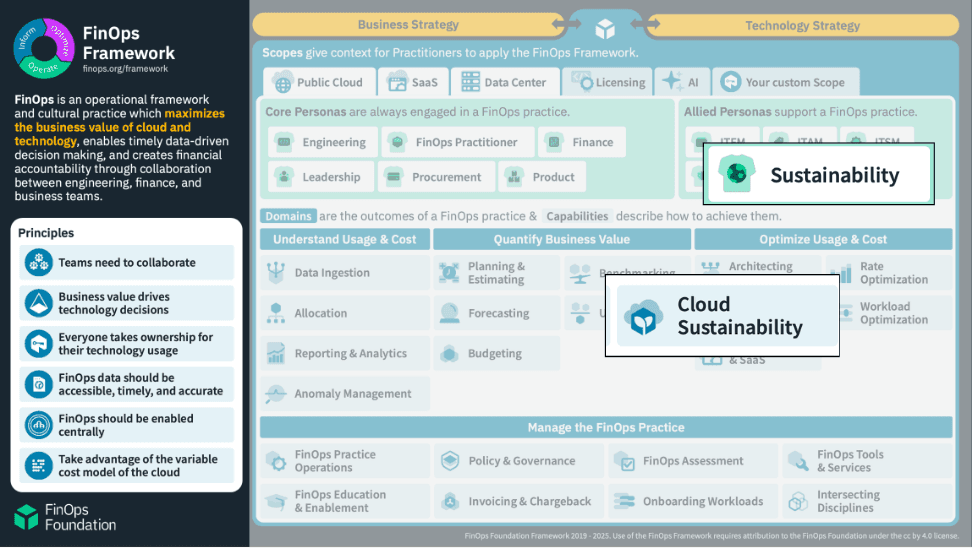
Please see FinOps Framework for full information from the FinOps Foundation on the cloud sustainability capability of the FinOps Framework.
A successful Crawl outcome would be a credible baseline, embedded in FinOps dashboards, that makes sustainability visible and discussable without creating a separate reporting universe.
Crawl should:
Build visibility and credibility for cloud sustainability (get to “carbon next to cost”)
Establish a defensible baseline that leadership and engineers trust
Put sustainability into the same operating rhythm as FinOps (daily/regular review, visibility, and quick wins)
Start showing that cost and carbon are not always proportional, so decisions need both metrics side-by-side
1. Immediate join to FinOps workflows
Daily-refreshing sustainability data designed to integrate into your chosen cloud cost platform, so carbon can sit next to cost in the same dashboards and allocation views.
2. Baseline you can trust (and defend)
Methodology aligned to the GHG Protocol and verified under ISO-14064, so teams aren’t stuck debating the numbers.
3. Inclusive of FinOps adjacent Business Tags
Carbon emissions (and also energy/water) by product or business tag so you can speak the language of TBM/finance/product owners early.
CSP native tools typically stall the Crawl phase because they make product-level reporting difficult and don’t preserve the business context you need for a “single pane of glass” across cost and carbon. Moreover, the data usually can’t be integrated into FinOps tooling in a way that supports real cost optimization motions. Finally, there is no electricity/water data, which blocks common KPI expectations (kWh/transaction, water intensity, etc.).
A successful Walk outcome is when Sustainability becomes a repeatable operational practice: teams can allocate, prioritize, and execute optimization work using the same FinOps motions guided by cost and carbon together.
Walk should:
Move from baseline reporting to repeatable action across engineering, product, and FinOps
Make sustainability allocatable and usable in the same views where teams manage spend (products, programs, cost centers, services)
Operationalize “carbon next to cost” into prioritization and decision-making
turn dashboards into actions (rightsizing, storage tier changes, scheduling/time-shifting, region decisions)
Increase adoption by giving stakeholders the level of detail they actually manage (team/product/service/resource)
1. FinOps-grade allocation and accountability
Usage-based sustainability metrics enriched line-by-line at the same grain as cloud billing, so teams can allocate emissions and intensity to products, programs, and owners (not just to a cloud account).
2. Actionable optimization decisions (not just reporting)
Granularity that supports “value-based actions” like rightsizing, instance types & storage tiers, time shifting workloads, and selecting greener regions, so teams can act directly on the drivers of cost and carbon.
3. Consistent multi-cloud comparisons for real planning
A comparable methodology across cloud providers so stakeholders can make apples-to-apples choices (and avoid mismatched CSP methodologies that block multi-cloud action).
4. Carbon-aware FinOps recommendations
Enrich existing FinOps recommendations by attaching carbon impact alongside cost, so the same optimization pipeline becomes sustainability-aware, without inventing a separate process.
CSP-native tools often stop teams at “Walk-lite” because the data isn’t granular or compatible enough for FinOps operating models: you can’t reliably allocate to products/programs, you can’t drive consistent multi-cloud actions, and you can’t integrate sustainability into the same cost optimization workflows where engineering already takes action. The result is lots of reporting, but limited optimization.
A successful Run phase is when Sustainability becomes part of how the organization runs cloud: normalized, auditable metrics are allocated and governed like cost, used to forecast and plan, and embedded into architecture and workload decisions from the start.
Run should mean:
Sustainability is embedded into governance and planning, not bolted on after the fact
Normalized, enterprise-ready metrics support multi-cloud reporting, regulation readiness, and decision-making at scale
“Shift left” becomes real: sustainability is considered before workloads are deployed or architectures are locked in
decisioning becomes preemptive (region strategy, architecture choices, workload scheduling, AI capacity planning)
Carbon, energy, and water metrics support mature KPIs and benchmarking (unit metrics, scorecards, targets)
1. Normalized multi-cloud reporting at enterprise scale
One actionable methodology across providers, enabling consistent reporting and decisioning across AWS/Azure/GCP, critical when products span multiple clouds and regions.
2. Audit-ready trust and transparency
A defensible dataset (transparent, accurate, auditable) aligned to recognized standards and verification expectations, so reporting can stand up to scrutiny and internal governance doesn’t stall on confidence debates.
3. Sustainability-by-design (“shift left”) decisioning
Advanced datasets and tooling inputs, like hourly grid carbon intensities, heatmaps for time-shifting, and decarbonization planning, so teams can plan where and when workloads run for best cost/carbon outcomes.
4. Sustainable AI optimization
Usage-based AI sustainability methodology that supports end-to-end AI usage analysis (including model sizing and token-related strategies), enabling governance and optimization as AI usage scales.
5. Benchmarking and KPI enablement
The ability to build robust KPIs and scorecards (including intensity-style KPIs) using consistent, granular metrics, so targets, performance, and progress are measurable and comparable across teams.
Run maturity depends on capabilities CSP-native tools typically can’t provide in a FinOps-operational way: cross-cloud normalization, allocation-grade granularity, auditable methodology, and integration into the same cost governance plane. Native tools may offer provider-specific reporting, but they don’t reliably support the “single pane of glass” and decision workflows needed for proactive optimization, forecasting, and sustainability-by-design.
Sustainability reports available for all cloud providers; data normalized across all cloud providers; data aligns to scope/granularity needed for reporting compliance
Greenpixie provides a single normalized multi-cloud methodology (AWS/Azure/GCP) with billing-line granularity and GHG-aligned, ISO-verified data suitable for compliance-grade reporting.
Sustainability reports visible to all teams impacted and shown alongside cost data
Greenpixie enriches cloud billing line-by-line and integrates directly into FinOps tooling, enabling carbon, energy, and water metrics to sit next to cost in the same dashboards and allocation views.
Sustainability targets (e.g. carbon budgets) communicated to all teams; all teams can track their progress against targets
Greenpixie’s allocatable, product/program-level dataset enables carbon budgets and KPI tracking at the same team and cost center granularity already used for financial accountability.
Impact on sustainability is considered during migration and optimization activities
Greenpixie attaches carbon impact to existing FinOps optimization levers (rightsizing, instance selection, storage tiers, region choice, workload timing), enabling sustainability to be evaluated alongside cost during migration and re-architecture decisions.
Clear guidelines for taking action when comparing all types of optimization options, and specifically when sustainability goals conflict with financial goals
By normalizing carbon data across providers and presenting cost and carbon side-by-side at the same grain, Greenpixie enables consistent, decision-ready comparisons when trade-offs arise between financial and sustainability objectives.
Work with Data Ingestion to obtain cloud provider and other vendor sustainability reporting and carbon data
Greenpixie ingests cloud billing and contextual datasets, enriching them with granular carbon, energy, water, and regional grid intensity data without requiring organizations to build and maintain complex in-house pipelines.
Cloud Provider and vendor sustainability contextual information and optimization recommendations used for decision making
Greenpixie provides contextualized comparisons across instance types, hardware, regions, and workload timing, enabling apples-to-apples carbon impact analysis across clouds.
Third party data and recommendations for carbon reduction opportunities
Greenpixie delivers verified, independent sustainability metrics and actionable reduction insights, avoiding reliance solely on provider-native reporting limitations.
Reporting & Analytics to ensure available sustainability data included in cost reports
Greenpixie’s FinOps-grade dataset integrates into existing cost reporting platforms and BI tools, ensuring sustainability metrics are embedded directly within standard cost analytics.
Unit Economics to ensure sustainability data included in key metrics
Greenpixie supports intensity-style KPIs (e.g., carbon per transaction, energy per workload, water per unit), enabling sustainability to be incorporated into unit economics and margin analysis.
Training, guidance to describe how to manage, view sustainability data (by team, application, etc.)
Through GreenOps enablement, sustainability-by-design guidance, and operational support, Greenpixie helps teams interpret and act on carbon data at the product, application, and team level.
Intersecting Disciplines where broader organizational sustainability groups exist and require specific reporting, data, or coordination
Greenpixie’s GHG-aligned, auditable methodology bridges FinOps, TBM, ESG, and sustainability functions, supporting enterprise reporting needs while maintaining allocation-grade granularity for operational teams.